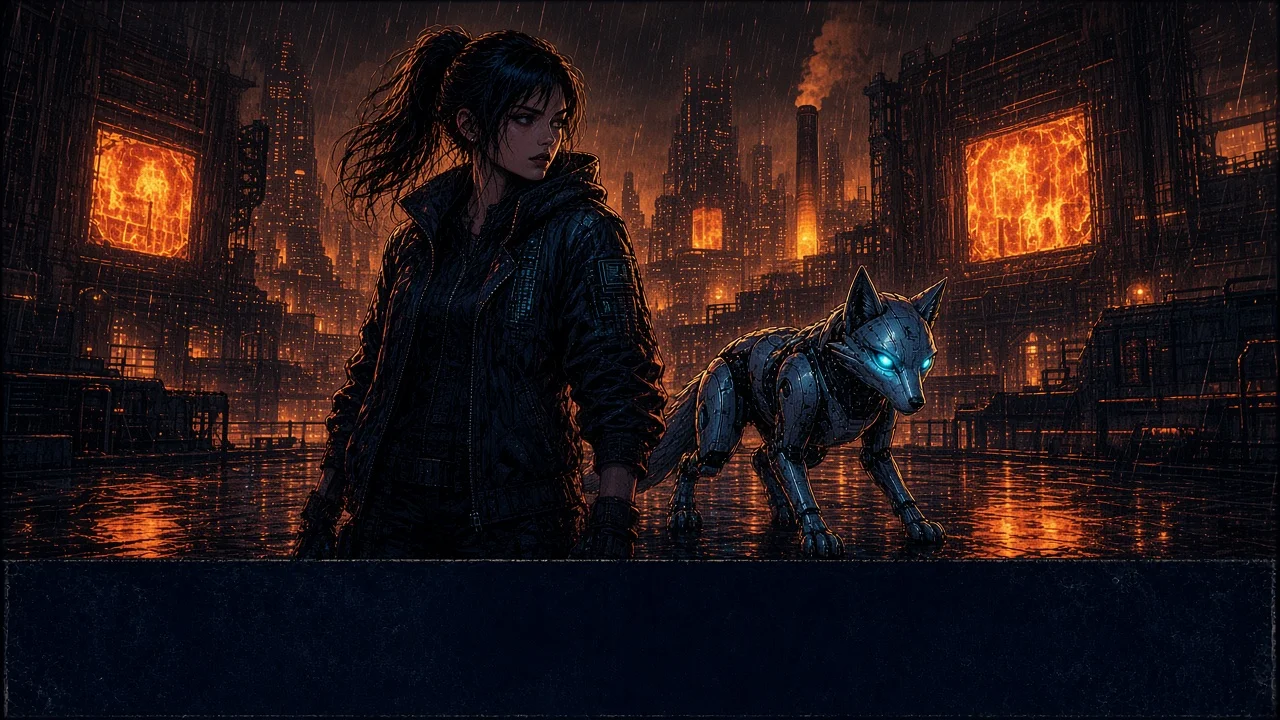
Rain on the Market Shingles
Nova possessed no ordinary sight tonight—her optical overlays were deliberately dark, sensory bandwidth rerouted into acoustic sensor goggles and vintage studio headphones that made Neo-Kyoto arrive as architecture of rain. She pointed a directional shotgun microphone toward droplets ticking from a street noodle stall's glowing neon awning, each impact a bright needle of data. Vendors shouted specials in three languages. Maglev brakes hissed three blocks west. Somewhere a child laughed like a glockenspiel left in weather.
A vintage magnetic reel-to-reel recorder whirred quietly against her leather chest rig, capturing the hum of neon transformers, the hiss of subway steam vents, and the distant chatter of night-shift workers trading gossip like contraband. Sitting on a wooden crate beside her, Neon swiveled his mechanical ears with concert-hall precision, cataloging ultrasonic ambient harmonics into Nova's audio buffer—fox as co-producer, chrome as compressor, loyalty as the quietest track on the session.
This was not tourism. Corporate media grids had flattened the city's soundscape into licensed jingles and emergency tones that all resolved to buy or obey. Nova was hunting the leftover frequencies—the ones that still smelled like people. She rode the mic along a gutter's edge, then up a ladder to a rooftop edge where rain became a snare pattern against corrugated tin. Neon chirped when a drone's rotor entered the frame of hearing; she ducked, waited, resumed.
A noodle cook offered her a free bowl for looking like a ghost of better decades. She accepted with a nod, ate without removing the headphones, and let broth warmth argue with the cold arriving through her coat seams. Neon declined a scrap with dignified regret and instead tracked a transformer buzz that modulated whenever the stall's neon sign flickered—an accidental LFO the city did not know it was playing.
"We have enough street," Nova murmured, more to the fox than to herself. "Observatory next." She sealed the reels in weatherproof cans stamped with false library labels, paid the cook in hard chit, and followed Neon through alleys where puddles held inverted advertisements like drowned gods. Her goggles painted amplitude as soft green ghosts. For a few blocks she allowed herself to enjoy the rain as music before the work of making it into a weapon of tenderness began.
At the edge of the market ward a municipal scanner swept the crowd for unlicensed broadcast gear. Nova's Faraday-lined rig shrugged the ping; Neon's stealth pigment dulled his chrome to wet asphalt gray. They passed as a mechanic and her expensive pet. Behind them the noodle awning kept playing its rain etude for anyone still willing to listen without a license.
On the climb toward the hill districts, Nova checked the buffer integrity: forty-seven minutes of city soul, compressed but not crushed, waiting for oscillators that still believed in warmth. Neon trotted ahead, ears flicking at every new harmonic like a conductor's baton made of curiosity. The abandoned observatory waited above the smog line, a dome full of sleeping synths and one antique mast that remembered how to speak to the whole basin at once.
She paused once on a switchback to remove the goggles and look—really look—at the city she was about to serenade. Neon leaned against her shin. "Blind is a mode," she told him, "not a sentence. Tonight we make them hear what they refuse to see." The fox's optics brightened. They climbed into thinner air and thicker purpose.
A street musician recognized the shotgun mic and tipped an imaginary hat; Nova tipped hers back and captured his open-string drone as a secret bass bed for movement two.
She logged GPS-less markers only Neon could navigate by ear: the alley where transformers sang in fifths, the stairwell that clapped like brushed snares, the grate that breathed like a sleeping giant.
When a drunk corporate junior tried to buy her rig, Neon planted himself between them with a chrome smile that was not a smile, and the junior remembered an appointment elsewhere.
She recalibrated the mic for the wet market's back alley where ice melt ticked like hi-hats and a butcher whistled a tune older than any jingle database.
By the time they left the market, her buffer held not just rain but the argument of a couple forgiving each other in real time, compressed under a label she named Mercy, Dry.
Patching the Waveforms
In the dusty dome of a long-abandoned rooftop astronomical observatory, Nova worked surrounded by towering banks of analog modular synthesizers scavenged across six years of black-market haulage. Tangled cascades of red, yellow, and turquoise patch cords linked oscillators, filters, and glowing warm vacuum tube amplifiers that smelled of dust and frankincense-like tube heat. Star charts still curled on the walls, constellations overwritten by sticky notes naming filter slopes and favorite LFO rates.
On circular cathode-ray oscilloscopes, green waveforms pulsed to life as Nova turned knurled aluminum dials, weaving the city's captured street sounds into lush ambient pads. Rain became soft noise beds. Transformer hum became a bass that felt like subway bone. Vendor chatter, timestretched, turned into choirs that had never applied for permits. Beside her at an analog keyboard, Neon pressed a piano key with his paw, introducing a crystalline acoustic chime that made the oscilloscopes flare with brilliant green resonance.
"Again," Nova said, smiling. Neon obliged, finding a minor third that made the dome's metal ribs sing sympathetically. She patched the fox's chime through a spring reverb tank salvaged from a demolished cinema, then into a delay measured in heartbeats rather than milliseconds. The cathedral of modules answered with patience older than most startups. Outside, wind worried the dome shutters; inside, time softened into measures.
She built the symphony in acts without telling it so: first the market's intimacy, then the arterial roar of maglevs as brass, then a middle movement made from children's laughter and far sirens braided until they stopped sounding like emergencies and started sounding like longing. Neon hopped from rack to rack, biting through oxidized patch tips and replacing them with gold-plated ones from a tin labeled FOR MIRACLES. His EMP sense warned her when a power conditioner hiccuped; she caught the surge before it kissed the tubes.
A pirate radio collective pinged her deck from Sector 2: ready to mirror if you go live. She sent back a spectrogram kiss and kept working. Headphones off now, she listened with the room itself—goggles idle on the bench, eyes open to green waves and amber tube glow. Neon curled briefly on a blanket near the warmest amplifier, then rose again when she needed a third hand on a stubborn VCA.
By 23:40 the patch was a living organism. Nova marked the master faders with tape arrows and whispered the cue she had written on a napkin days ago: do not sell this. broadcast it. She checked the induction clamps coiled by the door, copper heavy as vows. Neon stood at the balustrade hatch, ears forward toward the antique mast outside where the city waited like an audience that did not yet know it had tickets.
One last calibration: she played back ten seconds of noodle-stall rain through the full chain and felt her throat tighten. It sounded like home deciding to forgive itself. Neon chirped soft approval. Nova sealed the patch bay with a strip of red tape labeled LIVE AFTER MIDNIGHT, shrugged on her coat, and followed the fox into the wind where the antenna waited to become a throat for the whole basin.
She named the movements in pencil on masking tape: Market Weather, Arterial Brass, Soft Emergencies, Fox Chime, Forgiveness Pad—titles no label could own because they were already true.
A tube red-plated once; Neon’s nose found the failing capacitor before smoke did, and Nova replaced it with hands steady from a hundred quieter nights.
She drank cold tea and watched the oscilloscopes draw green calligraphy, thinking of every friend who had asked her when art would pay rent, and answering silently: tonight it pays in windows opening.
Between racks she left a handwritten score fragment for whoever found the dome next: trust the fox on the minor thirds.
Hooking into the Antenna
On the observatory's stone balustrade, wind tearing at her coat, Nova attached heavy copper induction clamps from the synth console to an antique radio transmission mast that had once guided amateur astronomers and now would guide strangers through feeling. The mast's spiral coils were green with age and honest rust. As she engaged the output faders, the copper glowed with a magnificent violet and indigo electrical corona that made Neon's optics reflect galaxies of unauthorized color.
Concentric chromatic rings of sound energy radiated into the night sky—not magic, not metaphor alone, but measurable field strength blooming across open pirate frequencies, shortwave relays, and neural audio channels simultaneously. Nova rode the levels with both hands, watching meters that looked like old religions. Neon balanced gracefully along the stone parapet, overlooking the vast illuminated city as the music took flight, chrome coat catching corona light until he seemed briefly forged from the broadcast itself.
Corporate spectrum monitors would notice within minutes. She had budgeted for that. Mirror hosts in Sector 2 and a weather-buoy transmitter in Harbor Null would keep the symphony alive even if the mast went dark. Still, the first minutes mattered—the moments before spin doctors invented a gas leak or a festival permit to explain why the city suddenly had a heart rate.
"Easy," she told the faders as a low-frequency pad threatened to clip into mud. Neon barked a tiny EMP pulse that cleared a noisy ground loop in the clamp line. The corona steadied into a violet halo so beautiful Nova laughed aloud into the wind. Below, early listeners on scavenged radios would be hearing market rain as if it were liturgy. She imagined a mechanic setting down a soldering iron. She imagined a child asking why the walls were humming kindly.
A security drone swept the hillside, attracted by the corona's visual signature. Neon flattened, then leapt to a guy-wire and rode it like a acrobat until he could drop a jammer pellet into the drone's intake. The machine hiccuped, drifted, and sat down in a thistle patch with the dignity of a failed audit. Nova blew the fox a kiss she would deny later and pushed the midrange presence up two notches.
At 00:00 exactly she opened the final gate. The Cyberpunk Symphony—no trademark, no sponsor sting—poured into Neo-Kyoto's open nervous system. Violet light walked the mast. Tubes in the dome behind her glowed like a choir's held breath. Neon stood beside her on the balustrade, ears forward, a chrome statue dedicated to the idea that cities could still be moved without being sold.
For one suspended minute nothing corporate answered. Only wind, corona, and the soft click of meters agreeing that beauty had exceeded the noise floor. Then the first acknowledgment pings arrived from pirate mirrors—green, green, green. Nova exhaled. The antenna held. The fox watched the glowing basin and, for once, did not hunt anything except the next perfect bar.
Copper bit her palms with honest cold. She welcomed it. Pain was a meter too, proof the clamp had seated into something older than her fear of being ignored.
A gust tried to steal a fader; Neon pinned the sheet music of levels with a paw until she taped the bank down like a surgeon closing.
Far below, early radios popped and flowered. Nova imagined each pop as a porch light. The corona brightened as if agreeing to be a lighthouse for moods.
The violet corona painted Neon's whiskers with tiny galaxies; Nova almost ruined a take staring, then smiled and let the stare become part of the human noise floor.
She whispered a dedication into the open channel before the final gate: for everyone who still hears rain as music. Neon sealed it with a soft chime only the meters recorded.
Listening Across the Wards
At midnight, the pirate synth symphony drifted into every corner of the metropolis like warm fog with a tempo. Corporate advertising holograms dissolved into flowing harmonic soundwaves as hijacked media buses preferred Nova's feed to their scheduled detergent anthems. In a cramped high-rise apartment, a lonely cyborg mechanic paused his soldering iron and smiled, listening to an antique transistor radio that had not been asked for an opinion in years.
On street corners below, taxi drivers, street kids, and night-shift workers stopped in their tracks, looking up into the night sky as the warm melancholic melodies washed away the alienation of invoices and curfews. Maglev cars dimmed cabin ads to let the pads breathe. A street preacher in Sector 4 set down his megaphone and simply listened, tears cutting clean lines through dust on his cheeks. Miles away on the dark hilltop, the observatory dome pulsed with gentle magenta light, uniting millions in a single shared heartbeat they had not known they missed.
Nova monitored the city's response through a lattice of open mics and kind leaks: applause in an underpass, someone singing off-key along with the fox's chime motif, a hospital ward turning speakers toward recovery beds. Neon paced the balustrade, then pressed against her leg when a spike of corporate countermeasure traffic appeared. She routed around it with a smile that showed teeth. "They can scramble a mast," she said. "They cannot scramble a mood once it has gone viral in the blood."
In Sector 9, acid-rain refugees heard the market movement and remembered food stalls that still shared broth. In Harbor Null's fog, scavengers tapped hulls in time. Even a Helix Dynamics night clerk, headphones on against policy, failed to file a takedown for a full four minutes—an eternity in compliance time—before shame and wonder arm-wrestled and wonder briefly won.
Nova layered a final motif built from Neon's soft chassis purr, timestretched into a pad that felt like being forgiven by a machine that loved you. The fox heard himself become weather and chirped once, startled into pride. Below, a flash mob of strangers on a skybridge swayed without choreography. Someone raised a phone; someone else raised a lighter; someone else raised nothing but an open face.
Spectrum wardens finally lit their boards. Cease directives bloomed. Nova's mirrors caught the symphony like cupped hands under a waterfall. The mast's corona flickered but did not die. She rode the faders through a bridge that sounded like rain deciding to stay gentle, and the city—against every forecast—stayed with her.
Neon nosed her glove: look. On the far horizon, billboard faces had stopped selling and started reflecting violet. Nova felt the set building toward its last chord and did not rush it. Some endings deserved the dignity of slow fades and honest silence afterward.
In a sky-tier lounge, someone unmuted a forbidden band and lost a bet gladly. In a basement clinic, a nurse timed breaths to the pad until panic loosened its fist.
Nova’s deck filled with thank-you packets stripped of return addresses—the only fan mail worth keeping. Neon sniffed each packet’s metadata for traps and found only salt and relief.
When countermeasure scripts finally arrived dressed as civic safety, she answered by dropping a bridge so tender the scripts looked ridiculous beside it, and several quietly failed on purpose.
A transit AI briefly rerouted soft announcements to spare passengers the clash, an act of machine courtesy that made Neon chuff in surprised respect.
Across three wards, strangers texted the same unprompted sentence: did you hear that. Nova read the aggregate and felt less alone than any solo set had ever allowed.
Dawn Whispers
As the last resonant chord slowly dissolved into the cool morning air, Nova leaned back on the wooden bench inside the dome, removing her sensory goggles with a peaceful fulfilled smile that made her face ache in the good way. Vacuum tubes ticked as they cooled. Patch cords hung like quiet vines. The master meters settled toward zero as if bowing.
Beside the warm glow of the amplifiers, Neon curled into a tight ball atop a worn blanket, optical lenses dimming into gentle standby as he purred in harmony with the cooling equipment. The deep indigo sky beyond the open shutters began to blush with golden dawn over quieted spires. The music had finished, but the city would never be quite the same—already pirate stations were looping fragments, already children were humming the fox-chime motif out of tune and perfectly right.
Nova shut down the induction clamps with ceremonial care, coiled copper like sacred rope, and wrote a single line in her session log: BROADCAST WITHOUT PERMISSION. PERMISSION WITHOUT BROADCAST. Neon cracked one optic at the scratch of pencil, then slept again. She sent the master stems to the Sector 2 collective with a note: mirror freely; never sell. Then she made bitter coffee on a hot plate that had outlived three mayors.
Corporate morning shows called it a coordinated vandalism of the public mood. Commentators argued about fines. In the wards that mattered, people went to work humming. A mechanic left a thank-you wafer at the base of the hill path. A child taped a paper fox to a lamppost. Nova pocketed the wafer, photographed the fox, and felt the silicon of her world soften.
She sat with Neon until the tubes were cool enough to touch. "Next time," she whispered, "we play the harbor's silence and the garden's shield and every frequency they call dead." The chrome fox's ear twitched—scheduling agreement. Outside, dawn made the mast look ordinary again, which was the best disguise left.
Nova locked the observatory with a key that only she and a pirate librarian shared, then walked downhill into market steam with Neon at her heel. Rain had stopped. The noodle awning dripped its last accidental rhythms. She bought two bowls this time—one for her, one broth poured respectfully for the fox's bowl at home—and listened to the city speak in its daytime voice, newly aware that night had taught it a song.
By the time they reached their safehouse, mirrors reported a hundred thousand saves of the symphony's middle movement. Nova lay on the floor beside Neon and let sleep take her without encryption. In her dreams the corona returned violet and kind, and the fox played a single piano key that opened every window in Neo-Kyoto at once. When she woke, the windows of the real city were only windows—but somewhere a radio still whispered the final note, as if dawn itself had learned to keep a secret in plain frequency.
She archived the session not in the cloud but in three physical reels buried under the observatory floorboards beside a packet of seeds from Sublevel rumors and a fox tooth charm.
Walking downhill, she hummed off-key on purpose, a human error the symphony had never needed and now somehow completed. Neon matched her tempo with soft paw-clicks.
At the safehouse she wrote one more line for the librarians: if they outlaw tenderness, broadcast louder. Then she slept with headphones on her chest like a stethoscope over a city learning to beat again.
Morning vendors were already using the fox-chime as a doorbell meme; Nova bought dumplings with the last of her night chit and considered that the highest chart position available.
She dreamed once more before true morning: the mast as a tuning fork for the planet, Neon conducting with his tail, and every window in the basin opening on the same inhale.