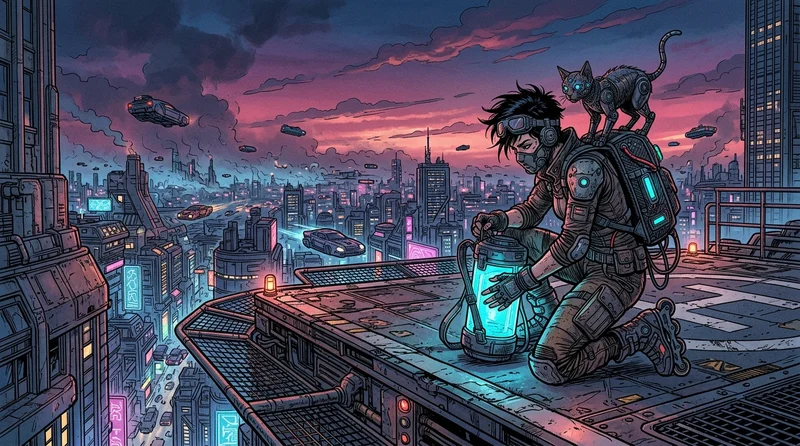
The Molten Bulkhead
Rumors of the secret greenhouse had circulated through the undercity for three generations, dismissed as a fairy tale by corporate historians who preferred maps without mysteries and ledgers without ghosts. Nova, a cyber-botanist with an ancient blueprint burned onto a glass wafer and a chrome fox who trusted green things more than green screens, knew better. The wafer had cost her a favor in Sector 2 and a week of sleepless triangulation through geothermal claim filings written to hide more than they revealed. Tonight the coordinates finally stopped drifting.
In a flooded maintenance corridor on Sublevel 14, she ignited her high-output plasma torch against a massive circular titanium blast hatch stamped with forgotten biohazard seals and a Helix Arbor crest so faded it looked ashamed. White-hot sparks rained into the dark water as the molten metal yielded, hissing like a nest of angry servers denied their sleep cycle. Neon perched on a dry conduit above the waterline, casting a steady cyan optical beam into the fragrant warm darkness within, ears forward, tail still as a held breath.
"If this is a trap," Nova muttered, bracing the torch against kickback, "it smells like honeysuckle." Neon chirped once—his shorthand for traps usually smelled like ozone and lies, not flowers. The hatch's last bolt surrendered with a sound like a coin dropped into forever. A pressure differential tugged at Nova's coat, drawing undercity damp toward cleaner air that should not have existed this far below the asphalt. She killed the torch, clipped it, and pressed a palm to the cooling metal until residual heat wrote itself into her synthskin as a temporary brand.
Behind them, a municipal pump cycle raised the water line by centimeters, licking at her boots with chemical cold. Nova timed the waves, waited for the trough, and swung the hatch inward on hinges that had not moved since before she was born. Warmth rolled out like a living welcome, carrying oxygen so rich her respirator briefly panicked and then sighed in relief. Neon slipped through first, optics painting soft paths across a catwalk that should not have existed on any corporate schematic filed after the Consolidation.
Nova followed, sealing the hatch enough to slow pursuit without locking themselves into myth. Her deck pinged a faint mesh of ancient horticulture protocols still gossiping on a band modern scanners ignored—soil gossip, moisture prayers, pollination schedules written like love letters. "Someone kept the lights on," she whispered. Neon's paws left wet prints that steamed faintly on warmer metal. Far above, geothermal mining drills hummed a threat the greenhouse did not yet know by name, a mechanical hunger chewing bedrock toward this impossible lung.
She checked the blueprint wafer against the chamber's curve and smiled despite the fear in her pulse. The fairy tale had walls. The fairy tale had air you could drink. And somewhere inside, according to a caretaker log dated forty years earlier and smuggled through three dead-drop gardens, something still pruned the roses. Nova wiped torch spatter from her gloves, nodded to Neon, and stepped fully into the impossible humidity while the undercity's cold tried to follow and failed at the threshold, as if the hatch itself had opinions about what belonged.
A secondary sensor on her wrist tasted pollen counts that official air-quality boards listed as extinct for this district. She laughed once, quiet and dangerous, and filed the reading under evidence for people who still believed extinct meant gone rather than hidden. Neon glanced back toward the sealed wet corridor, then forward into green dark, choosing the story that still grew.
She marked the hatch on three offline maps and one paper napkin, because redundancy was how gardens survived accountants. Neon watched the ink dry as if it were another kind of shield.
The plasma torch cooled on her hip like a sleeping animal; she promised it quieter work next time, pruning metal instead of doors, if the world ever learned manners.
The Bioluminescent Canopy
Stepping through the shattered airlock onto a high catwalk, Nova stopped dead in her tracks and let her respirator mask fall to her chest. Before her stretched an impossible subterranean paradise: an immense geodesic cavern filled with towering bioluminescent willow trees whose glowing cyan and lilac fronds cascaded into a crystal-clear freshwater lake. Mist soft as breath hung between the trunks. The ceiling's glass panels caught and multiplied every living light until the whole dome felt like a lung made of stained glass and stubborn hope.
Mechanical pollination dragonflies flitted through warm oxygen-rich air scented with damp moss and wild honeysuckle. Their wings ticked with tiny servos; their abdomens glowed with pollen maps older than most municipal codes. Neon balanced on the catwalk railing, robotic optics wide with wonder at the sight of a living ecosystem flourishing miles beneath asphalt that sold itself as the only reality worth mapping. He chirped a question Nova translated without effort: is this real. She answered by breathing until her lungs hurt sweetly.
Paths of pale stone wound between root flares and irrigation channels lined with ceramic older than the city charter. Nova knelt, touched a frond, and felt a faint data tickle—plant-side mesh, gentle, curious, non-predatory. "They wired the garden to listen," she said. "Not to sell. To care." Neon hopped down and sniffed a patch of moss that glowed when his chrome nose brushed it, leaving a temporary constellation of fox-shaped dark that made her want to photograph a moment no camera could price.
Across the lake, a small island held a control pagoda overgrown with jasmine so thick the windows looked like green stained glass. Status lanterns burned steady green. No corporate logos survived on any surface; someone had scraped them away with the patience of decades and the theology of pruning shears. Nova's deck logged species that official seed banks listed as extinct, then listed again under classified agricultural assets, then listed nowhere. She laughed once more. Extinct was often another word for inconvenient to quarterly reports.
A soft chime rolled through the canopy—not an alarm, a greeting tuned to frequencies that felt like hospitality. Neon's ears swiveled toward the pagoda path. Nova followed the fox down switchback stairs, boots soft on stone worn by caretaker feet that might have been brass or flesh or both across the years. At the water's edge she cupped a handful of lake and tasted mineral sweetness free of industrial bitter. "Sublevel Mirage," she murmured, naming what the rumors had never quite dared to finish. "You are not a mirage. You are a refusal wearing leaves."
Far above the dome, a vibration shivered dust from a high panel and made the willows flicker as if flinching. Neon growled low, chrome throat resonating. Nova's smile thinned. Paradise had a clock, and the clock was corporate steel chewing bedrock on a schedule accountants loved. She sealed a sample vial for the pirate botanists waiting on the surface mesh, labeled it CLOSED SUN, and moved toward the pagoda where the garden's last guardian waited among roses of brass and moss.
Along the path, instructional plaques in three dead dialects explained companion planting as if companionship itself were a technology worth teaching. Nova ran her fingers over the raised letters and felt less alone than she had in any sky-tier cafe. Neon paced ahead, then back, then ahead again, a chrome metronome counting down the minutes before the drills remembered this column of rock.
Between the willows, Nova found a child's shoe fossilized in moss and left it where it lay, a museum of play that needed no curator besides Carel-7's patience.
Pollen clung to Neon's whiskers until he sneezed a tiny constellation of gold that the lake briefly held like a second sky.
The Rose of Brass and Moss
Walking down a winding stone pathway soft with moss, they met the garden's sole protector: an antique four-armed agricultural automaton nearly three meters tall, its weathered bronze plating entwined with flowering jasmine and soft green lichen that had decided metal was soil enough. Pruning shears slept in two hands; a watering ladle rested in a third; the fourth held a perfect blooming red organic rose as if it had been waiting for this exact arrival since before Nova learned to solder.
The ancient machine paused and knelt before Nova with graceful slowness that made the catwalks above seem hurried and slightly embarrassed. Its central optical lens glowed with gentle amber warmth, the color of late lamps in rooms where someone still waited up. Neon stepped onto a mossy rock, extending a delicate paw to sniff the velvety petals, receiving a soft mechanical purr from the giant that vibrated the stone under Nova's boots. She bowed without irony. "Designation?" she asked. The automaton's voice arrived like gravel polished by decades of rain: CAREL-7. KEEPER OF THE CLOSED SUN.
"The closed sun still shines," Nova said, gesturing at the bioluminescent canopy that painted Carel-7 in lilac and cyan. The automaton inclined its head and offered the rose. She accepted it, thorn careful, and tucked it into a water sleeve on her pack where it could keep breathing. In return she held up the blueprint wafer. Carel-7 scanned it, then projected a holographic timeline across the lake surface: founding, sealing, decades of solitary maintenance, children's laughter logged as acoustic weather, and a red spike labeled GEOTHERMAL CLAIM approaching from above like a knife pretending to be progress.
"They will puncture the dome," Nova translated for Neon, though the fox already watched the red spike with narrowed optics and a tail held low. Carel-7's shears opened and closed once, a gesture that might have been grief practiced until it became etiquette. Nova jacked a soft handshake into the automaton's horticulture bus and felt centuries of patient logs—soil pH, visitor dreams, the names of children who had once played here before the hatch was welded shut and called safety. "We can reinforce," she said. "If you will trust a trespasser who brought a fox and a torch."
Carel-7 placed a brass palm on the stone between them. Trust protocols unfurled as pollen diagrams, delicate and exact. Neon walked into the diagram without hesitation, and that, more than Nova's credentials or her stolen wafer, unlocked the deeper controls. Together they moved toward an overgrown control room where analog mainframes still dreamed in vacuum tubes and moss had learned to leave the keyboards clean out of respect for music it could not play.
Inside, vines parted for Carel-7 like old friends making a path for a reunion. Nova's deck sang as it met machines that spoke in horticultural metaphor: storms meant power spikes, winters meant coolant, spring meant every system green and forgiven. She smiled into the amber light until her cheeks hurt. "All right, Closed Sun. Show me your shields before the drills write a different ending." Carel-7's lens brightened. Neon hopped onto a console and rested both paws on a grounded plate, ready to become surge protection dressed as loyalty.
Warning glyphs began to wake on their own as if the garden itself had overheard the bedrock conversation above. Nova cracked her knuckles, patch cords ready, and felt the rose against her pack pulse once like a second, softer heart.
When Carel-7 spoke of the closed sun, Nova heard every sealed door she had ever cut open answer in harmony, a choir of refusals learning to share sheet music.
Carel-7 taught her a watering rhythm older than tariffs; she logged it under MUSIC rather than AGRICULTURE, because some protocols deserved better categories.
Seismic Shockwaves
The peaceful reverie shattered with a deep seismic shudder that shook dust and dried leaves from the ceiling in a brown snow that tasted of old wood and new fear. Far above, corporate geothermal mining drills had begun boring through bedrock, threatening to puncture the fragile geodesic glass dome with the indifference of a spreadsheet. Water in the lake shivered into concentric panic. Bioluminescent willows flickered as if the light itself flinched. Mechanical dragonflies scattered into higher branches and went dark to listen.
Nova rushed into the overgrown control room, frantically plugging her cyberdeck into the analog mainframe to redirect backup fusion power toward the dome's kinetic shields. Patch cords became vines in her hands; she followed Carel-7's pollen diagrams and Neon's urgent chirps toward breakers labeled in a dead technician's handwriting that looped and hurried the way handwriting does when someone loves a place. Warning glyphs bloomed amber, then crimson, then a color that had no polite name.
Beside her, the moss-covered automaton braced a severed high-voltage bus bar with heavy titanium arms, braving crackling electrical arcs to maintain the circuit while jasmine blossoms trembled without burning—some old kindness in the insulation chemistry, some miracle of care written into materials science. Neon raced along cable trays, biting through corroded safeties that would have tripped the shield grid into suicide mode out of outdated caution. Sparks danced across his chrome like medals he refused to wear.
"Come on," Nova hissed at a progress bar older than her and somehow more anxious. A second seismic hit knocked her to one knee and filled her mouth with dust. Through a cracked observation slit she saw a hairline fracture race across a high glass panel like a rumor becoming policy. Mist began to leak upward like escaping prayer. Carel-7 roared—a sound like a greenhouse collapsing in reverse—and shoved more power into the bus until the room smelled of hot rain and stubborn metal.
Nova overrode the fusion governor, accepting a risk that would have voided every corporate warranty ever printed and several that had not been invented yet. Heat washed the control room in waves. Neon's chrome reflected the overload as a liquid sunrise. On her HUD, shield nodes woke one by one around the dome's hex grid, turquoise and trembling, each confirmation a small absolution. "Hold," she told the garden, the fox, the giant, herself. "Hold like you have held for eighty years."
Above, the drill bit screamed as it met something it had not budgeted for: a kinetic barrier singing in frequencies that made rock remember it could be gentle. Dust rained. The fracture stopped growing mid-sentence. Nova did not yet cheer. Shields were promises, and promises needed locking with more than hope. She slammed a final breaker, felt the dome settle into a deeper turquoise hum, and tasted blood where she had bitten her lip without noticing.
Carel-7's arms smoked faintly. Neon pressed against the automaton's shin, grounding static. Nova wiped her face with a sleeve that smelled of honeysuckle and ozone and whispered the only prayer she trusted: stay.
The drill's scream faded into a sulk; Nova imagined the claim report already rewriting failure as geological anomaly, and she blessed the lie with both hands.
She triple-checked the fusion governor lockouts and etched a fox glyph into the breaker panel so future trespassers would know a chrome witness had stood here and chosen the garden.
When the hex shield sang, Nova tasted copper and honeysuckle together and decided that was the flavor of a city learning to protect what it could not sell.
An Immortal Sanctuary
With a resonant chime that rolled through the canopy like a temple bell grown from glass, the emergency forcefield engaged fully. A magnificent translucent turquoise hexagonal barrier enveloped the entire subterranean cavern, deflecting seismic vibrations from the world above into a silence so sudden Nova's ears rang with the absence of threat. The lake smoothed to mirror. Willows brightened as if exhaling. Carel-7 sank to one knee, arms smoking faintly, moss singed but intact, lens dimming to thoughtful amber.
By the calm waters of the lake, Nova and the gentle robot sat side by side on ancient stone steps, watching bioluminescent lotus blossoms drift across the mirror-like surface like slow punctuation in a sentence about survival. Neon batted playfully at a glowing mechanical butterfly hovering near the shoreline, then returned to lean against Carel-7's brass shin as if adopting a second guardian without filing paperwork. Nova unbound the rose and set it floating among the lotuses, a small red yes in a field of light.
"They will try again," she said, because honesty was another kind of gardening. Carel-7's lens flickered in agreement. Nova uploaded shield schematics and a live integrity feed to the pirate botanist mesh, then seeded false telemetry into the geothermal claim's sensors—enough soft lies to convince accountants that this column of rock was unprofitable, unstable, and spiritually offensive to quarterly optimism. Lies in defense of gardens felt like holy work, and she did not apologize to her ethics module.
She left Carel-7 a quantum dead-drop bead keyed to Neon's unique EMP bark pattern. "If the barrier falters, call us. We dig faster than their drills, and we bring better tools than their claims." The automaton offered a second rose. Nova shook her head gently, smiling. "Keep that one growing where we can find it again." Neon pressed his forehead to Carel-7's plating, a chrome blessing, then trotted toward the hatch path with the satisfied gait of a fox who had helped a sun stay closed and living.
At the threshold Nova looked back once. The Sublevel Mirage glowed like a held secret that had decided to live forever and invite occasional guests who knew how to weld and listen. She sealed the hatch from the wet corridor side, welded a new lie over the old seals, and wiped her blueprint wafer clean of everything except a single private glyph: CLOSED SUN STILL SHINES. Water licked her boots again; it felt less like a threat and more like a moat.
Back in the undercity's upper markets by dawn, Nova sat under a rain awning with Neon curled at her boots and listened to the first new rumor take root. A vendor swore the geothermal crew had hit a cursed vault. A courier claimed the rock sang. A child insisted she had dreamed of glowing willows and a fox made of mirrors. Nova sipped bitter coffee and did not correct anyone. She forwarded anonymized soil samples to three trusted gardens and one untrusted journalist who was, paradoxically, reliable about wonders.
That night she updated her private map of Neo-Kyoto with a new layer titled REFUSALS—places that had said no to erasure and meant it. The Sublevel Mirage glowed there like a seed. At dawn a ping arrived from Carel-7: STATUS GREEN. LOTUSES OPEN. FOX REMEMBERED. Nova laughed aloud in the empty safehouse and showed Neon the message. Somewhere beneath kilometers of corporate bedrock, an immortal sanctuary kept breathing—and the city above, without knowing why, felt a little less thirsty for green.
In the safehouse she slept with the rose's scent still ghosting her pack, dreaming of hex grids and foxes, and woke knowing the mirage had become a neighbor she would die to keep.
By noon she had recruited two more dead-drop gardeners with nothing but a soil vial and a story about brass hands that pruned like prayer; Neon approved each recruit with a solemn sniff.
She left a final note in the dead-drop: if you find this garden, bring water, leave logos, and listen when the fox tells you which roots still remember your name.
Nova finished her coffee, paid the vendor in hard chit, and walked into the morning crowd with Neon at her heel, carrying a map that now included a sanctuary no drill would find cheap to destroy.